Curriculum Overview

At Tudor Grange Primary Academy Yew Tree, we provide a rich, ambitious and thoughtfully designed curriculum that builds the knowledge, skills and understanding of all children as they progress through school. Our curriculum incorporates the statutory requirements of the National Curriculum while offering a wide range of engaging experiences, enrichment opportunities and purposeful learning contexts that nurture curiosity, independence and a genuine love of learning.
We place a high priority on securing strong foundations in the fundamentals of reading, writing and mathematics. These core skills are taught daily, ensuring all pupils acquire the essential tools needed for learning and life.
In Early Years, the Foundation Stage Framework and Development Matters underpin a curriculum that provides daily opportunities to read, write and apply mathematical understanding, supported by well‑planned provision that develops children socially, emotionally and physically.
Our ambition is for all pupils to develop a love of reading. Phonics and early reading are taught through Little Wandle Letters and Sounds in EYFS and Key Stage One. As pupils move through Key Stage Two, the teaching of reading follows the Christopher Such approach, ensuring that children access high‑quality texts and develop deep comprehension through explicit instruction in vocabulary, inference, prediction, retrieval, explanation and summarisation.
In mathematics, we follow a mastery approach using the White Rose Maths scheme. Through a CPA approach (concrete–pictorial–abstract), all children are supported and challenged to become confident mathematicians. In addition to daily maths lessons, all pupils receive a focused arithmetic session each week to secure fluency in key number facts and procedures.
Our curriculum is progressive and carefully sequenced, enabling children to build securely on prior knowledge as they move through each year group. Enrichment opportunities, such as visits, visitors and special events, enhance learning further by making meaningful links to real‑world experiences. A wide range of after‑school clubs, led by staff and external experts, also broadens the learning offer.
Knowledge Organisers:
To support the introduction of new units in our Foundation Subjects, we use Knowledge Organisers to outline key concepts and essential vocabulary. These provide a helpful reference for pupils during lessons and give families insight into upcoming learning.
Sample Knowledge Organisers:
Assessment:
Assessment is purposeful and designed to celebrate progress while identifying next steps.
- Children complete termly assessments in reading and spelling.
- In mathematics, pupils are assessed at the end of each block to check understanding and inform future teaching.
- At the end of each foundation subject unit, pupils complete short, age‑appropriate assessments that summarise the key knowledge gained.
Sample Foundation Assessments:
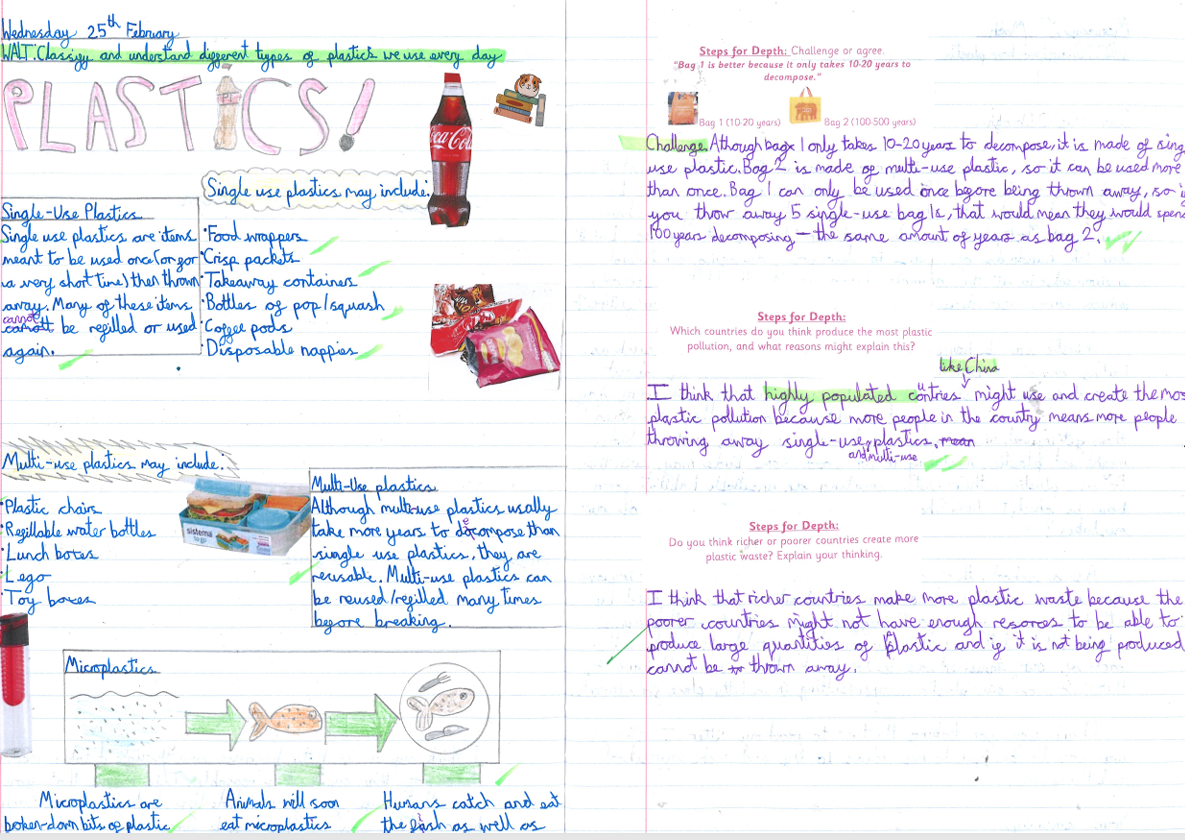
In each lesson learning is further extended through Steps for Depth, carefully designed tasks that deepen understanding, provide meaningful challenge and allow children to explore concepts at greater complexity.
Our weekly blog posts celebrates the creativity, curiosity and achievement taking place across school each week, providing families with an insight into how our curriculum inspires and motivates learners.